

Not all pool leaks are created equal. The material your pool is built from has a big impact on where leaks tend to form, how hard they are to find, and what it takes to fix them. If you’re a South East Queensland pool owner trying to understand your leak, here’s what to know about your specific pool type.
Concrete Pools
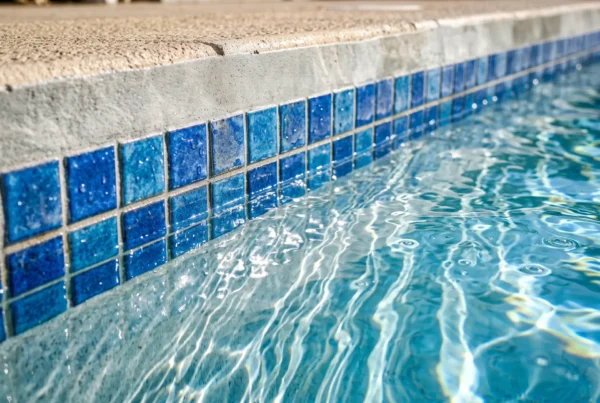
Concrete (or “gunite”) pools are the most common structural type in SEQ, and they’re also the most likely to develop multiple small leaks rather than one obvious one.
Common leak points:
- Hairline cracks in the shell, especially around steps, benches, and corners where stress concentrates
- Failed joints where the pool meets tiled edges or coping
- Cracked or degraded render/surface finish
- Fittings such as lights, skimmer boxes, and return jets where they penetrate the shell
Concrete is porous by nature, so a small amount of water loss can be normal. The challenge is distinguishing ordinary evaporation and porosity from an active leak. Because concrete pools are usually plumbed with pipes running underneath or through the shell, leaks can also occur well away from the visible crack, which is why professional pressure testing is often needed rather than just a visual inspection.
Fibreglass Pools
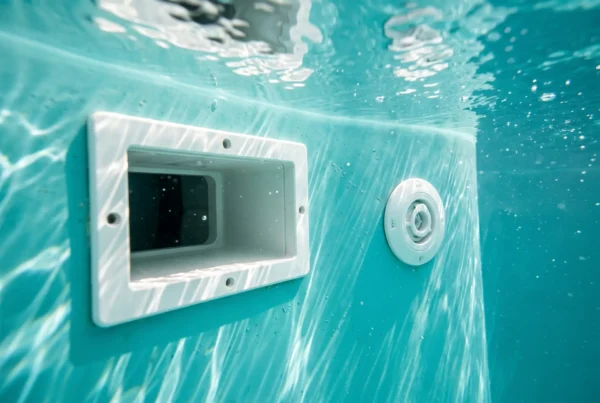
Fibreglass shells are moulded as a single piece, so they’re generally far less prone to structural leaks than concrete. When fibreglass pools do leak, it’s almost always at a fitting or penetration point rather than through the shell itself.
Common leak points:
- Skimmer box seals
- Light niches and light cable conduits
- Return jets and main drain fittings
- Occasionally, gelcoat cracking from ground movement or an underlying void beneath the shell
Because the shell itself is usually sound, fibreglass leaks are often quicker and cheaper to resolve; the difficulty is usually locating the exact fitting responsible, since water can travel along the outside of the shell before it becomes visible.
Vinyl Liner Pools
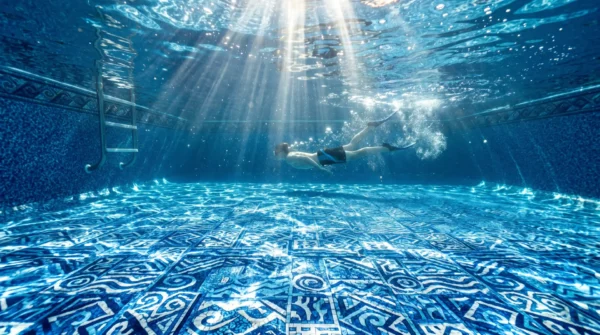
Vinyl liner pools are less common in Queensland than concrete or fibreglass, but they do exist, particularly in older builds. The liner itself is the weak point.
Common leak points:
- Small punctures or tears in the liner, often near steps, ladders, or where debris has caused wear
- Seams where liner panels are joined
- Fittings behind the liner, including skimmer and return connections
- Wrinkles or folds that develop into weak spots over time
Vinyl leaks can sometimes be found visually (a tear is often visible once the pool is drained slightly), but underwater patch repairs are usually possible without a full liner replacement, provided the leak is caught early.
Why This Matters for Detection
Because each pool type fails differently, the detection approach needs to match the material. A technician working on a concrete pool will typically focus on pressure testing the plumbing lines and dye-testing suspect cracks. On a fibreglass pool, the focus shifts almost entirely to fittings and penetrations. On a vinyl pool, visual inspection combined with underwater dye testing is often enough to find the culprit.
This is also why a generic “one size fits all” approach to leak detection can miss the mark, and why it pays to use a technician who works across all three pool types regularly and knows what to check first.
Not Sure What Type of Leak You Have?
If you’re seeing water loss but aren’t sure whether it’s structural, a fitting issue, or just evaporation, the safest first step is a proper inspection. Our team services concrete, fibreglass, and vinyl pools across South East Queensland and knows exactly where to look for your specific pool type. Get in touch to book an inspection.